Your Board Has Blind Spots. This Assessment Finds Them.
17 questions across governance, composition, member voice, and financial transparency. No interpretation. No survey analysis. You score it. You see the pattern.
This is not a survey that tells you what you want to hear. It's a mirror.
Download it now.
You'll have your assessment in minutes and your score immediately.
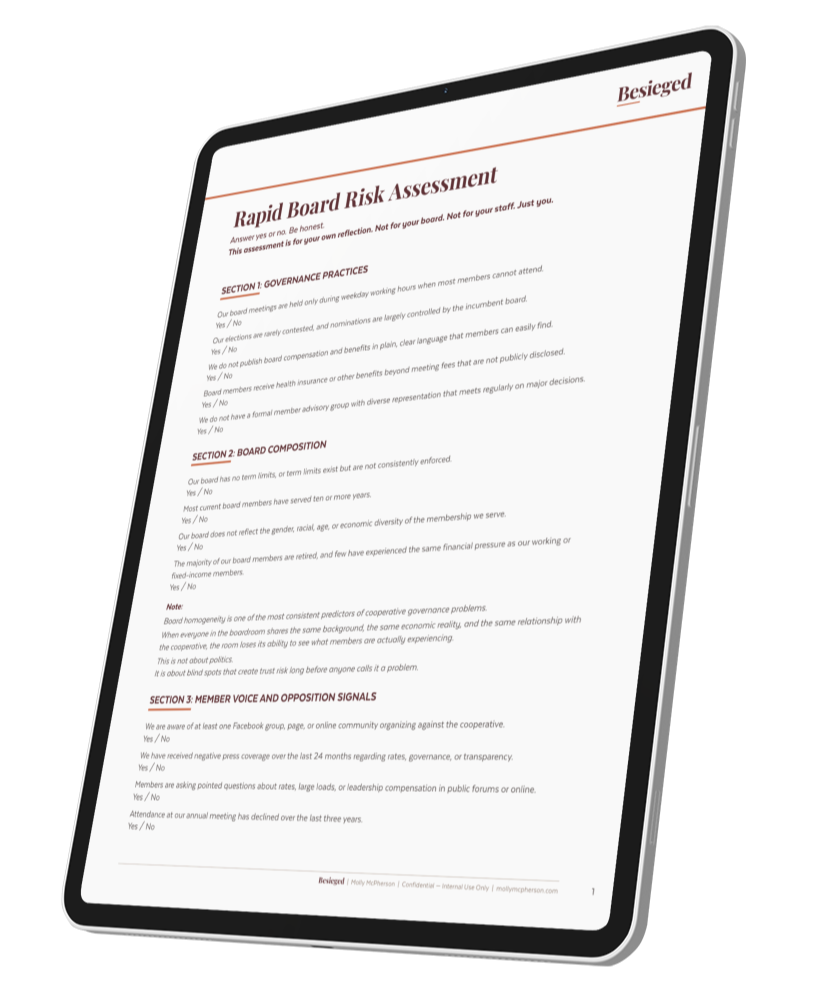
This assessment maps the vulnerabilities that show up before the Facebook groups form, before the press calls, before members organize.
It's built around four patterns: governance practices that erode trust, board composition that creates blind spots, member opposition signals you might be missing, and financial transparency gaps that become targets under scrutiny.
You answer 17 yes-or-no questions honestly. You get a scored result that tells you whether you're in prevention mode, elevated risk, or crisis conditions. Then you work through the debrief questions. That's where the real diagnostic happens.
GET INSTANT ACCESS NOW
Molly McPherson
@molly.mcpherson
Crisis strategist. Reputation meltdowns + life behind the analysis.
Why This Exists
This work is not theoretical. It is built from direct, repeated exposure to how backlash actually unfolds inside electric cooperatives. I have trained directors and CEOs through NRECA. I have worked alongside G&T cooperatives and statewide associations on communication strategy, media training, and crisis management. And I have seen what happens when pressure hits before leadership is aligned.
I have been inside the Facebook groups where frustration turns into momentum. I have attended the town halls where members stop asking questions and start making accusations. I have been in the boardrooms where leaders are trying to respond in real time, without a shared framework for how to do it.
This is where most guidance falls apart. Because most communication advice is built from the outside looking in. This is built from being inside it. Electric cooperative backlash is different. It is not driven by headlines first. It is driven by members. Ownership. Expectation. And when that shifts, it does not behave like a typical PR issue.
Besieged exists because this pattern is predictable. And most leadership teams are still treating it like it isn’t.